

The Form Cue That Fixes Overstriding Without Thinking About Your Feet
How do you fix overstriding? Forget your feet. Try one research-backed cue, "run quieter", plus a simple 3-week plan to land closer under your body.

Telchatta Kumar
The Form Cue That Fixes Overstriding Without Thinking About Your Feet
Listen to this article · English
The easiest way to fix overstriding is to stop thinking about your feet and simply try to run more quietly. In a 2017 study, runners who spent 15 minutes trying to make less noise cut their impact peak by about a quarter, and the change carried over to running outdoors. A quieter landing naturally pulls your foot back under your body, shortens your stride and reduces braking, without you having to micromanage where your foot goes.
Key takeaways
- Overstriding means your foot lands well in front of your body with a nearly straight knee, which acts like a brake.
- Heel striking is not the same as overstriding; where your foot lands matters more than which part touches first.
- The cue "run quieter" reduced impact peak from 1.56 to 1.13 times body weight in a 2017 lab study.
- External cues (sound, rhythm) tend to work better than internal ones (body parts) for movement skills.
- Practise in short blocks for about three weeks, then let it become automatic.
What overstriding actually is
Overstriding is when your foot touches down well ahead of your centre of mass, usually with the knee almost locked and the shin angled forward. Picture someone reaching out with their leg to grab the road.
That reaching foot creates a braking force on every step. Your body has to absorb it, then push to get moving again. Over thousands of steps per run, that adds load to the knee and shin and wastes energy.
Heel striking isn't the villain
For years, runners were told to switch to a forefoot strike. But most recreational runners land heel first, and reviews of footstrike research, including Hamill and Gruber's 2017 paper, have found little evidence that switching strike pattern helps most runners. You can land on your heel with your foot close under your hips and a soft knee; that is not overstriding.
What matters is where the foot lands and how the leg is positioned, not which part of the shoe touches first. If you want the longer story, read what 15 years of barefoot running research concluded.
Why "land under your hips" often backfires
The classic advice is to focus on your feet: land under your hips, land midfoot, pull your foot back. Many runners try this and end up stiff, awkward and tired.
There is a reason. Decades of motor-learning research, much of it led by Gabriele Wulf, shows that people usually learn movements better with an external focus (an effect on the world) than an internal focus (a body part). Running is no exception. In a 2009 study by Schücker and colleagues, trained runners had better running economy when they focused on their surroundings than when they focused on their running movement.
In plain terms: the more you think about your feet, the clunkier you may become. You need a cue that changes your feet without you watching them.
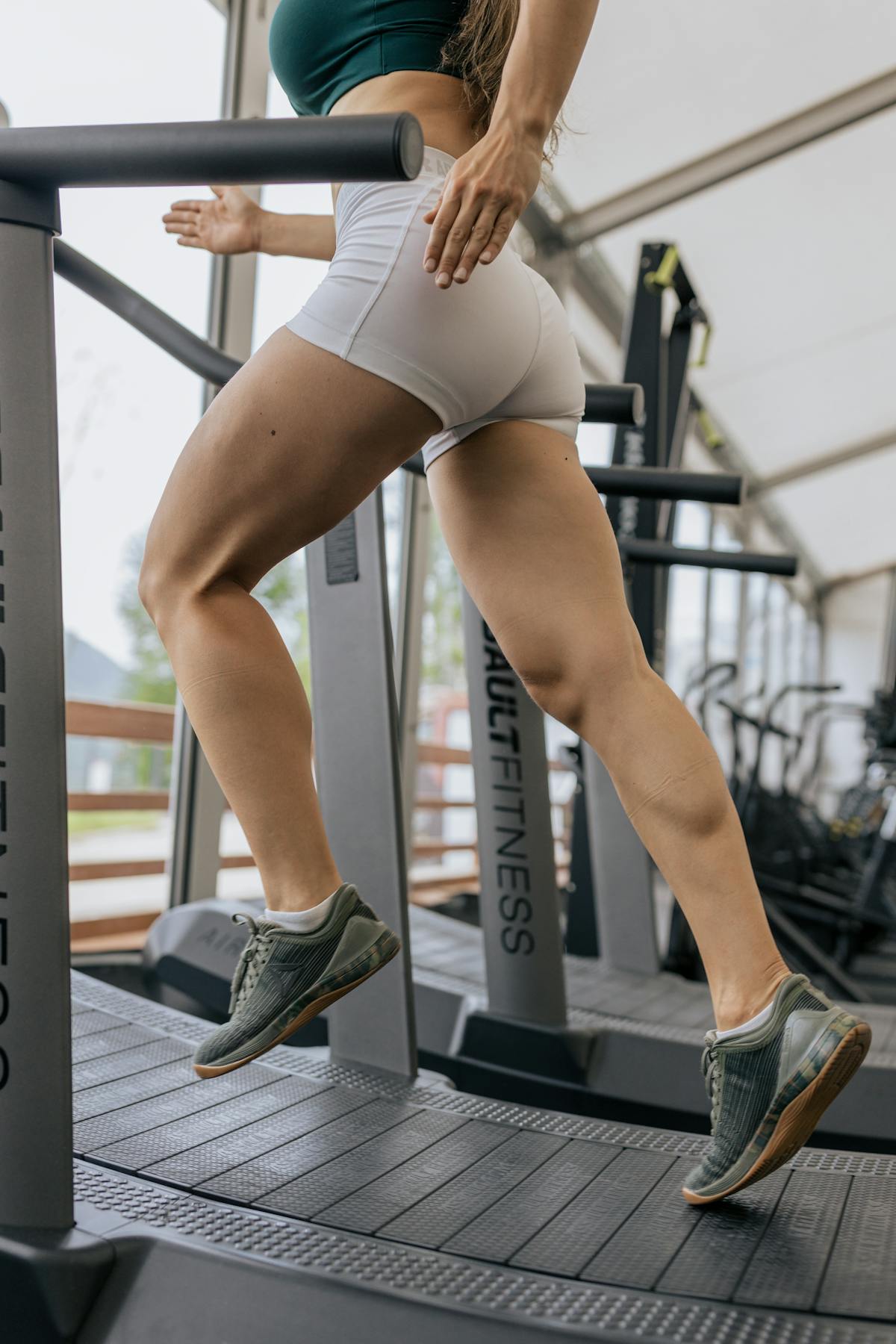
The cue: run quieter
Here is the cue: make less noise when you land. That's it.
What the study found
In a 2017 study in the Journal of Orthopaedic & Sports Physical Therapy, Jeremiah Tate and Clare Milner gave 14 runners real-time feedback from a decibel meter on a tablet and asked them to reduce the sound of their running for 15 minutes on a treadmill. Afterwards, measured during normal overground running:
- Vertical impact peak fell from 1.56 to 1.13 times body weight.
- Average loading rate dropped from about 69 to 44 body weights per second.
- About 80% of runners cut all three loading measures by 20% or more.
It was a small, short-term study, so it does not prove fewer injuries. But it shows how strongly a simple sound-based cue can change the way you land, and that the change carried off the treadmill.
Why it works
To land quietly, your body has to stop slamming a straight leg into the ground. Most runners respond by bending the knee a little more at contact, placing the foot closer under the body and taking slightly shorter, quicker steps. That is exactly the fix for overstriding, and you got there by listening, not by staring at your shoes.
A backup cue: rhythm
If "quiet" doesn't click, use rhythm. Set a metronome 5% above your normal cadence (for example from 160 to 168 steps per minute) and match it. Heiderscheit's 2011 study found that a 5–10% increase reduced braking and knee loading. For why you shouldn't chase 180, see why the 180 cadence rule is a myth.
Your 3-week plan to fix overstriding
Lab gait-retraining programmes typically use around eight sessions over two to three weeks, with feedback gradually removed so the new pattern becomes automatic. Here is a practical version.
Week 1: Learn the sound
- 3 runs, each with 3 × 3 minutes of "quiet running" inside an easy run, at a pace such as 6:15/km (10:03/mile).
- A treadmill is ideal at first: it's easy to hear yourself. Turn music off.
- Keep the same pace. You're changing the landing, not the speed.
Week 2: Take it outside
- 3 runs, each with 3 × 5 minutes of quiet running on a smooth path or track.
- Every few minutes, check in for 10 seconds: can you hear your feet? Make them quieter.
Week 3: Fade the cue
- 2 runs with 2 × 10 minutes of quiet running, then just one check-in per kilometre (0.6 miles).
- By the end, the goal is to forget about it. Check by filming yourself.
How to check your progress
Film from the side with your phone in slow motion, at running pace. Pause on the moment your foot first touches the ground:
- Is your foot landing close to under your knee, rather than far ahead of it?
- Is your knee slightly bent, not locked?
- Is your shin close to vertical rather than angled far forward?
Compare a clip from day one with one from week three.
Common mistakes and safety notes
- Tiptoeing. Running quietly on your toes can overload the calves and Achilles. Aim for soft, not bouncy; let your heel come down.
- Changing too much at once. Don't combine a form change with a mileage jump or new shoes.
- Expecting magic. Strength still matters; pair this with a 15-minute strength routine, and remember that warming up, not static stretching, is the better pre-run habit, as covered in why stretching before a run doesn't prevent injuries.
Mild calf soreness in the first week is common. Sharp pain, pain that lasts more than a few days, or pain that changes how you walk is not. Stop, and see a physiotherapist or sports doctor, especially if you have a history of shin or stress injuries.
Find your next race on Runtra
A smoother stride makes every kilometre cheaper. Put it to work: browse upcoming races, pick a half marathon to build toward, or search for 10K races to test your new form.
FAQ
How do I know if I'm overstriding?
Film yourself from the side in slow motion and pause when your foot first touches the ground. If your foot is far in front of your knee, your knee is almost straight and your shin angles forward, you are likely overstriding. A loud, slapping footfall is another common sign.
Is heel striking the same as overstriding?
No. Heel striking describes which part of the foot lands first; overstriding describes where the foot lands relative to your body. You can land on your heel with your foot close under you and a bent knee, which is fine for most runners.
What is the best cue to stop overstriding?
"Run quieter" is one of the simplest, research-backed options. In a 2017 study, trying to reduce landing noise cut impact peak and loading rates by around 20% or more in most runners. A metronome set about 5% above your normal cadence is a good alternative.
How long does it take to fix overstriding?
Most runners can learn a new landing pattern in about two to three weeks of short, regular practice blocks, similar to lab gait-retraining programmes. After that, reduce the reminders so it becomes automatic, and re-check with video.
Can overstriding cause injuries?
Overstriding increases braking forces and the load absorbed at the knee, which may contribute to problems such as knee pain or shin issues in some runners. The evidence linking impact forces to injury is mixed, though, so if you already have pain, see a physiotherapist rather than relying on form changes alone.